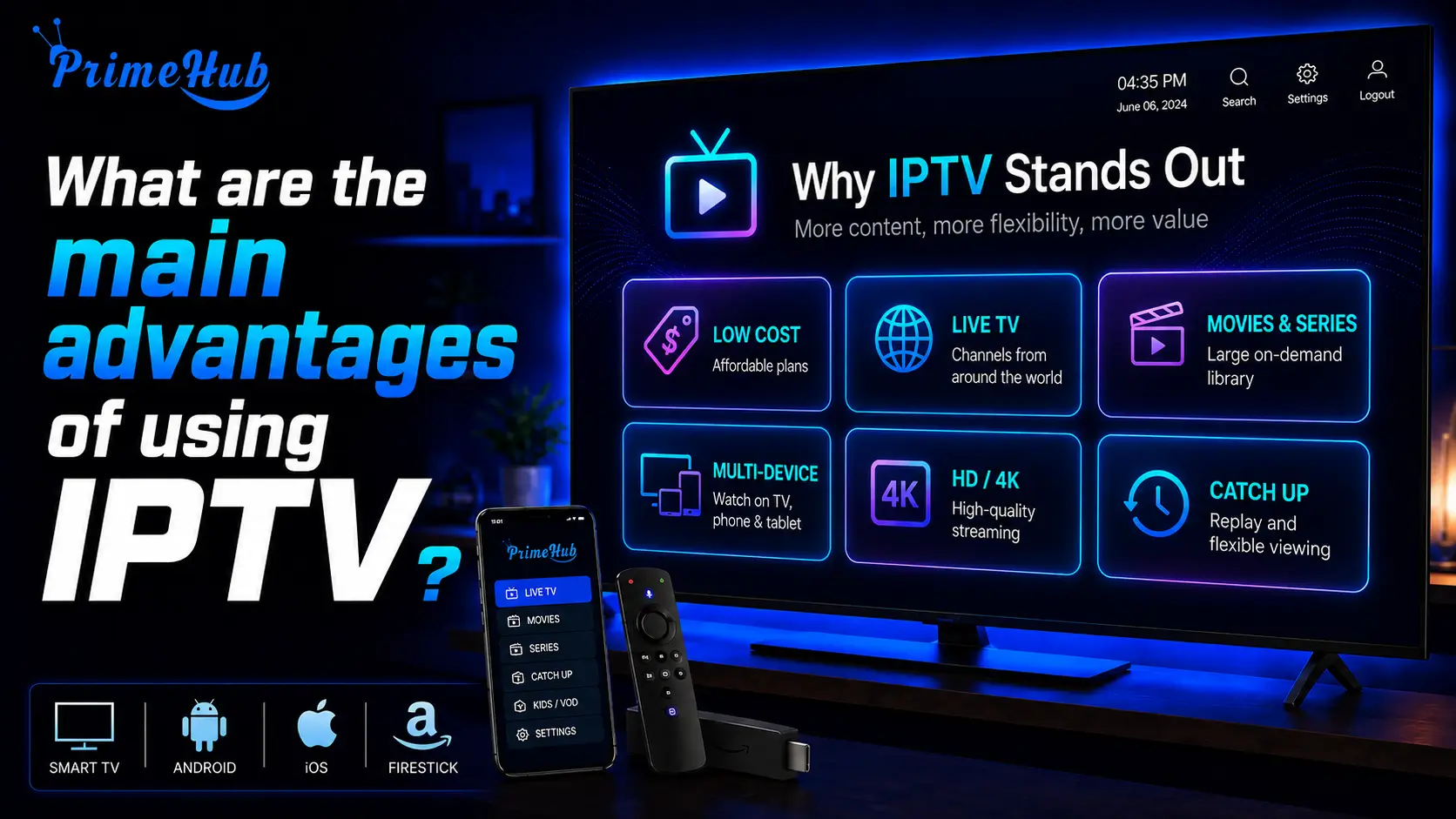
The main advantages of IPTV are lower cost, on-demand access to films and series, the ability to watch on any device, no dish or engineer visit, catch-up television, and access to channels from other countries. Because programmes travel over your existing internet connection rather than a dedicated cable or satellite signal, the service adapts to you instead of the other way round.
You choose the device, the room and often the moment. The trade-off is that everything depends on the quality of your connection and the reliability of your provider. With a dependable provider like IPTV USA, however, most households find that the added flexibility is worth far more than what it costs.
Traditional television was built around a single fixed point in the home: one line, one box, one screen, one schedule. IPTV removes almost every part of that arrangement.
Here is what that actually changes in daily use.
It costs noticeably less than cable or satellite
The clearest advantage is price. IPTV services generally cost a fraction of a traditional television package, because there is no physical infrastructure to build or maintain.
Cable and satellite operators carry enormous fixed costs, networks, dishes, engineer visits, equipment rental. Those costs appear on your bill whether you use the service heavily or barely at all.
An IPTV provider delivers over infrastructure that already exists. There is no line to install, no dish to mount, and usually no equipment to rent. Most services also work month to month, so you are not committed to a two-year contract for a package built around channels you never watch.
You are not tied to one screen or one room
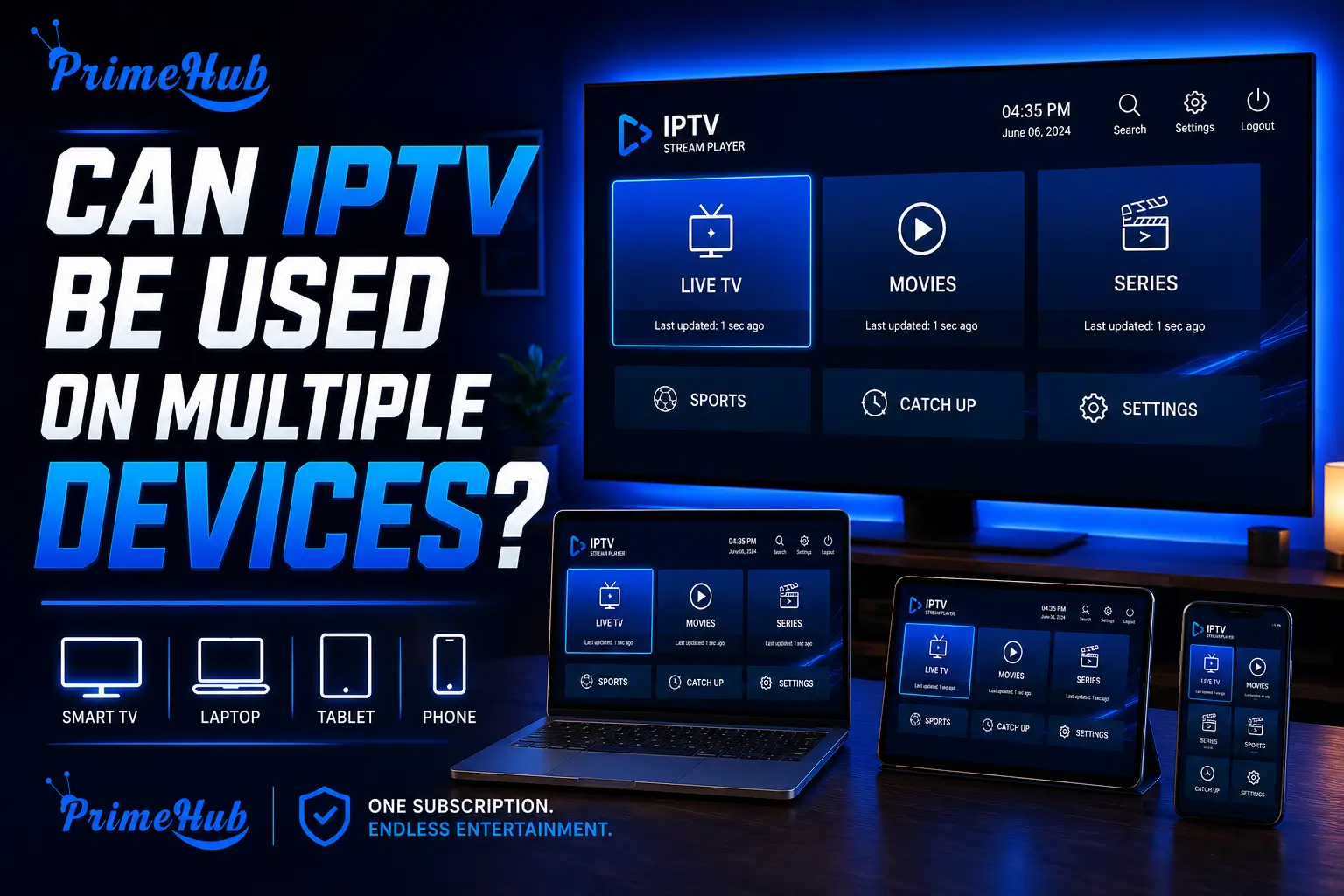
With IPTV, the same subscription works on a television, a laptop, a phone and a tablet, which is something traditional television never managed properly.
Cable was designed around a box in the living room. Watching elsewhere meant a second box, a second subscription, or nothing at all.
IPTV works differently. Most plans allow more than one stream at a time, so one person can watch in the living room while another watches something else in a bedroom, all on the same account. You can carry on watching on a phone while cooking, or on a laptop in another room. The service follows you around the house rather than anchoring you to one sofa.
Films and series are available on demand
Most IPTV subscriptions include a video library alongside live channels, meaning you can start a film whenever you want rather than waiting for it to be scheduled.
This is only possible because of how IPTV is delivered. Broadcast television sends the same signal to everybody simultaneously, so it cannot respond to individual requests. IPTV sends each viewer their own stream.
The practical result is that one subscription covers both habits: live channels for news and sport, and an on-demand library for everything else. Households that would otherwise pay for a television package and one or two streaming services often find that a single service covers most of what they actually watch.
How well that library is presented varies between providers. The better ones supply cover images, plot summaries and release years, which makes browsing feel like a mainstream streaming platform. It is worth asking about before subscribing rather than after.
You can rewind, pause and catch up
IPTV lets you pause live television, rewind a few minutes, or replay a programme that finished hours ago. Traditional broadcasting cannot do any of this without a dedicated recorder.
Catch-up is the most useful of these features. Depending on your provider, you can scroll back through the guide by anywhere from a few hours to about a week and replay something already broadcast, as though it were on-demand content.
This changes how a household plans its evening. Missing the start of something stops mattering. Nobody has to negotiate over what gets recorded, and there is no storage to manage or delete.
Availability varies by channel and by provider, so it is not universal. Where it exists, though, it removes one of the last real constraints of scheduled broadcasting.
Setup is quick and there is no dish
Getting started with IPTV takes minutes rather than days, with no appointment, no drilling and no equipment fitted to your building.
Traditional installations involve waiting for an engineer, agreeing an appointment window, and accepting permanent changes to your property. For renters and flat-dwellers that is often impossible, many buildings simply do not allow a dish.
IPTV needs only a device you already own and an internet connection you already pay for. You enter your details, your channel list loads, and you are watching. If you move house, you take nothing with you and set nothing up again beyond signing in.
Access to channels from other countries
IPTV makes it straightforward to watch channels from other countries, which traditional television handles poorly or not at all.
This is one of the strongest practical reasons households choose it. Families living abroad can follow news and programming from home in their own language. People learning a language get access to authentic material. Households with mixed backgrounds can cover several at once.
Cable and satellite are built around national markets, and international packages, where they exist, tend to be expensive add-ons with limited selections. IPTV removes that geographic boundary almost entirely.
How IPTV compares with traditional television
The differences are easier to see side by side.
| IPTV | Cable or satellite | |
| Installation | Minutes, self-service | Engineer visit required |
| Equipment | Devices you already own | Rented box, often a dish |
| Contract | Usually monthly | Often 12–24 months |
| Devices | Phone, tablet, laptop, TV | Mainly the television |
| On-demand library | Usually included | Extra cost or unavailable |
| International channels | Wide access | Limited, expensive |
| Depends on | Your internet connection | A dedicated line or dish |
The final row is the important one. Everything IPTV does well comes from using your internet connection, and everything it does badly comes from the same place. That single dependency explains both sides of the ledger.
You only pay for what you actually use
IPTV lets you match what you pay to what you watch, instead of buying a large package for a handful of channels.
Traditional television bundles hundreds of channels together because that is how licensing deals are structured. Most households watch a small number of them regularly, yet pay for the entire bundle every month.
IPTV plans are usually smaller, cheaper and easier to change. If your viewing habits shift, a sports season ends, children grow out of something, you can move to a different plan without penalties or a phone call to a retentions department. The absence of long contracts is not a marketing detail; it changes the balance of power in your favour.
The interface is more flexible than a set-top box
With IPTV you choose the player application, which means you choose how your television looks and behaves.
On cable or satellite, the interface is fixed. If the guide is slow, the layout confusing, or the remote awkward, that is simply what you have for the life of the contract.
IPTV separates the content from the interface. If a player feels sluggish or its guide is hard to read, you install a different one and keep the same subscription. You can also organise things properly, build a favourites list, hide the hundreds of channels you never open, put sport and news where you want them. Ten minutes of tidying makes a bigger difference to daily use than almost anything else.
What you give up in exchange
An honest look at the advantages needs the other side, because the trade-offs are real.
- Everything depends on your connection. If your internet is unstable, your television will be too, and no provider can fix the last few metres of your home network.
- Quality varies between channels. Some look sharp, others soft. That is decided at the source and cannot be improved from your side.
- Programme guides have gaps. Popular channels are usually well covered; smaller and foreign-language ones frequently are not.
- Support quality varies widely. This is one of the clearest differences between a serious provider and a marginal one.
- You do the setup yourself. It takes minutes rather than days, but nobody comes to do it for you.
None of these outweigh the advantages for most households, but knowing about them in advance prevents the disappointment that comes from expecting something the technology does not offer.
Legal services and the ones to avoid
IPTV as a technology is entirely legal, and so are the player applications used to watch it. Television delivered over the internet is a mainstream method used by telecom operators and major broadcasters worldwide.
What determines legality is the source. A subscription from a licensed operator, or a list of freely broadcast channels their owners have made public, is perfectly lawful. A service redistributing paid channels without permission is not, and using one carries genuine risk in most countries.
There are practical reasons to avoid unauthorised services too. They vanish without warning, take payment for periods they never deliver, offer no realistic way to recover money, and their sites and applications are a recurring source of malicious software.
A few warning signs are worth weighing before subscribing anywhere:
- Channel counts that seem impossibly large
- Prices far below what licensing could plausibly cost
- Payment methods with no buyer protection
- No verifiable company information anywhere on the site
- Marketing that stresses the absence of contracts rather than the quality of the service
Frequently Asked Questions
Is IPTV cheaper than cable?
Usually yes, and often substantially. There is no infrastructure to maintain and no equipment rental.
Can I watch on more than one device?
Yes, up to your plan’s simultaneous stream limit — typically one to three.
Do I need a dish or an engineer visit?
No. IPTV uses your existing internet connection, and you set it up yourself in minutes.
How fast does my internet need to be?
Around 10 Mbps per high-definition stream and 25 Mbps or more per 4K stream.
Does IPTV replace my internet service?
No. It runs on top of your existing connection and uses bandwidth from it.
Can I watch programmes I have already missed?
Usually, if your provider offers catch-up. Archives typically go back from a few hours to about a week.
Is the picture quality as good as satellite?
On well-served channels, yes. Quality varies more between channels than it does on traditional television.
Do I have to sign a long contract?
Rarely. Most services work month to month, which is one of the main practical advantages.
Will it work if my internet is slow?
Not reliably. A stable connection matters more than a fast one, but both help.
Is IPTV legal?
The technology and the apps are legal everywhere. Whether a particular service is legal depends on whether it holds rights to what it carries.
Conclusion
The main advantages of IPTV come down to one shift: television stops being a fixed installation and becomes a service that adapts to you. It costs less, it needs no dish or engineer, it works on the devices you already own, and it follows you from room to room.
Add on-demand films, catch-up television and access to channels from other countries, and the gap against traditional packages is substantial, particularly for renters, for households that watch across several screens, and for families with connections to more than one country.
The trade-offs are equally clear. Everything rests on your internet connection, quality varies between channels, and you handle the setup yourself. These are real limitations, not marketing caveats.
For most households the balance falls firmly on the side of IPTV. Choose a properly licensed provider, use a wired connection where you can, and spend ten minutes organising your channel list. Those three decisions will shape your experience far more than anything else.