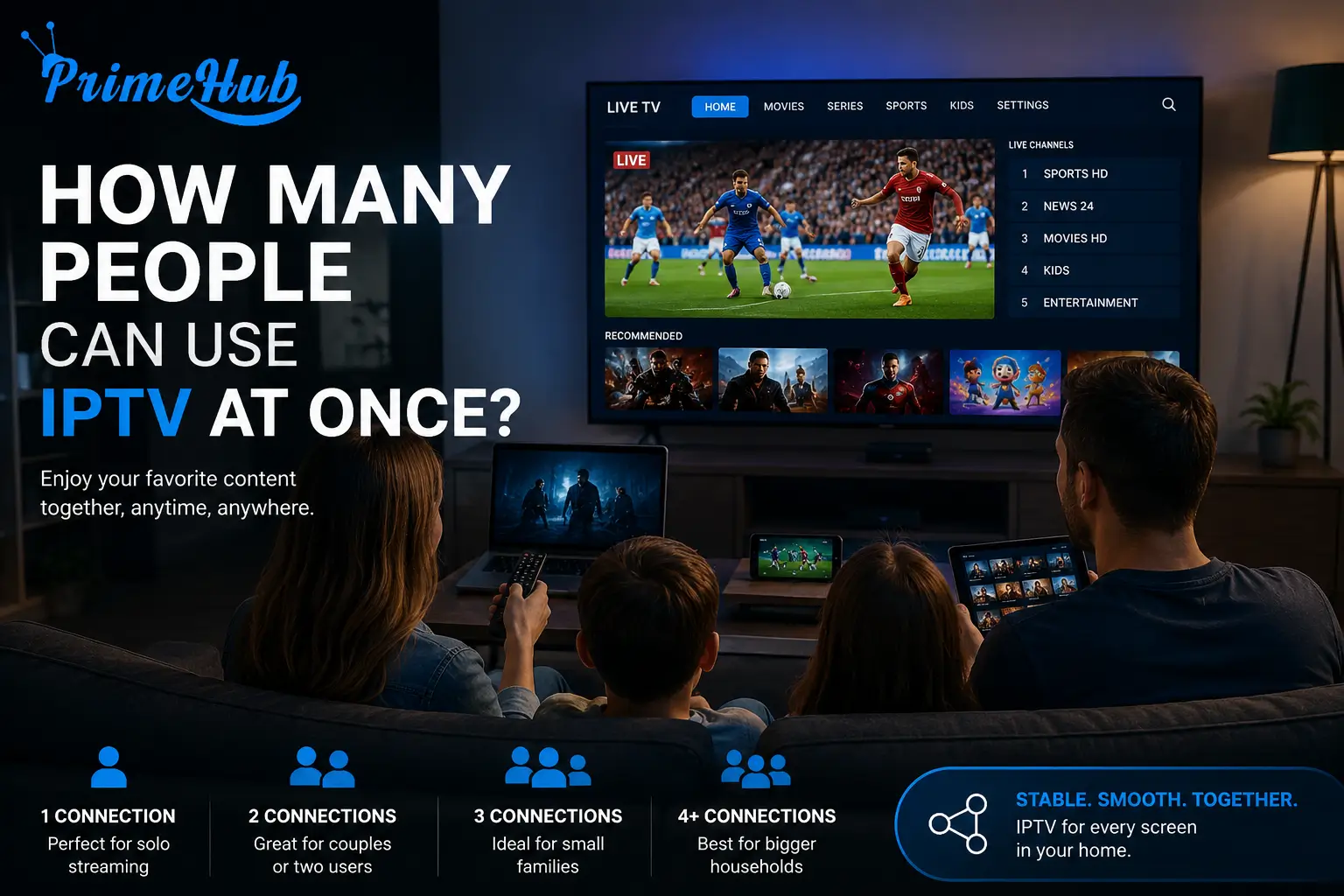
The number of people who can use IPTV at once depends primarily on your subscription plan (most allow 1 to 3 simultaneous connections, premium plans up to 5 or more), your internet bandwidth (each HD stream requires around 5–10 Mbps, 4K needs 25+ Mbps), and the provider’s multi-device policy. Whether you’re a single user with one TV or a large household with multiple screens, the number of simultaneous viewers is one of the most important factors when choosing your subscription.
For households looking for reliable simultaneous streaming, IPTV USA is a trusted provider offering flexible plans for one or several users, premium 4K stability, and a wide channel selection that supports multi-device streaming without interruption.
In this guide, you’ll learn exactly how many people can use IPTV at the same time, why providers set connection limits, how bandwidth affects multi-user streaming, what happens when you exceed the limit, and how to choose the best plan for your household. Each section gives you a direct answer in the first sentence, followed by clear explanations easy to follow even for beginners.
How many simultaneous connections does a typical IPTV subscription allow?
A typical IPTV subscription allows between 1 and 3 simultaneous connections, while premium plans can support 4 to 6 or even unlimited connections depending on the provider. The standard entry-level plan is usually limited to 1 device at a time to keep prices low and prevent account sharing.
Premium and family-oriented plans are designed for larger households, offering 3 to 5 simultaneous streams across different devices (Smart TV, Fire Stick, phone, tablet, laptop).
Always check the provider’s plan page before subscribing to confirm the exact number of allowed connections, as exceeding this limit can lead to account suspension or temporary disconnection on all devices.
Why do IPTV providers limit the number of simultaneous users?
IPTV providers limit the number of simultaneous users to protect server capacity, prevent account sharing, and ensure fair usage across all subscribers. Without these limits, a single account could be shared between dozens of users, overloading the servers and degrading streaming quality for everyone.
These limits also help providers offer competitive pricing. Each simultaneous stream uses server resources (bandwidth, processing power, content licensing). A subscription with 1 connection costs less than one with 5 connections, which is fair for solo users who don’t need multi-device support. Account sharing is detected automatically through IP tracking and device fingerprinting.
How does bandwidth affect the number of users on one IPTV subscription?
Bandwidth directly affects how many users can stream IPTV at the same time on one subscription: each HD stream needs about 5–10 Mbps, and each 4K stream needs at least 25 Mbps. Even with a multi-device plan, your internet connection must be strong enough to handle all simultaneous streams.
For a 3-person household streaming in Full HD, plan for a stable 30 to 45 Mbps. For 4K streaming on 2 devices, you’ll need at least 50–60 Mbps. According to Wikipedia’s reference page on IPTV technology and its delivery mechanisms, high-quality multi-stream delivery requires not only sufficient download speed but also stable latency and minimal jitter, especially during peak hours when network congestion is most likely to affect overall performance.
Can multiple family members watch IPTV at the same time on different devices?
Yes, multiple family members can watch IPTV at the same time on different devices, as long as your subscription plan allows it and your internet bandwidth is sufficient. This is one of the biggest advantages of IPTV over traditional cable: each user can enjoy their own content on their own screen.
For example, one person can watch a sports match on the TV in the living room, another can watch a movie on a tablet in the bedroom, and a third can stream their favorite series on a smartphone — all at the same time. To learn the basics of setting up and using IPTV across multiple devices, check our complete guide on how to use IPTV service which explains the multi-device configuration step by step.
What happens when you exceed the IPTV connection limit?
When you exceed the IPTV connection limit, your stream is blocked, your account may receive a warning, or it can be temporarily suspended depending on the provider’s policy. Most IPTV services detect the issue immediately through IP and device fingerprinting.
The most common consequences include:
- Immediate disconnection on all devices currently streaming.
- “Connection limit reached” error message displayed.
- Need to wait for one of the existing connections to disconnect.
- Possible account warning sent by email.
- Repeated abuse may lead to permanent account ban.
To avoid these issues, always upgrade to a plan that matches your real household usage instead of trying to bypass the limit with proxies or multiple logins.
How can you check how many connections your IPTV plan supports?
You can check how many connections your IPTV plan supports by looking at your subscription confirmation email, the plan details on the provider’s website, or directly in your customer portal. Most reputable providers clearly indicate the number of allowed simultaneous streams on the pricing page.
If the information is not clearly visible, contact customer support — a serious provider will always be transparent about connection limits.
For more details on the available subscription options and the number of connections offered with each plan, visit our IPTV subscription main page which lists the technical specifications and household coverage of each option in clear detail.
What’s the best IPTV plan for a large household?
The best IPTV plan for a large household is one that offers at least 3 to 5 simultaneous connections, supports HD and 4K streaming, includes the channels and VOD content your family enjoys, and provides reliable customer support. Multi-device plans are typically marketed as “family,” “premium,” or “multi-screen” plans.
When choosing the right plan, consider these key factors:
- The number of people who will stream at the same time.
- The devices each person will use (Smart TV, mobile, tablet, console).
- The total household bandwidth available from your ISP.
- The need for 4K streaming on the main TV in the living room.
- Special interests of household members (sports, kids’ content, international channels).
A well-chosen plan eliminates the frustration of “connection limit reached” errors and lets every family member enjoy their favorite shows without compromise.
Comparison Table: IPTV Plans by Number of Simultaneous Users
Here is a complete comparison of IPTV subscription types based on the number of users, bandwidth needs, and household size.
| Plan Type | Simultaneous Streams | Bandwidth Needed | Best For |
| Solo / Basic | 1 device | 10–15 Mbps | Single user, one TV |
| Standard / Duo | 2 devices | 20–30 Mbps | Couple or 2-person household |
| Family / Multi-screen | 3 devices | 30–50 Mbps | Family of 3–4 |
| Premium / Pro | 4–5 devices | 50–80 Mbps | Large family, multiple TVs |
| Unlimited / Business | 6+ devices | 100+ Mbps | Reseller, shared accommodation |
Conclusion
The number of people who can use IPTV at once depends entirely on three factors: your subscription plan, your internet bandwidth, and the provider’s multi-device policy. Most plans support between 1 and 5 simultaneous streams, with premium options offering even more flexibility for large households.
To enjoy uninterrupted streaming, match your plan to the actual number of users in your home, ensure your internet connection can handle the total bandwidth, and choose a reliable provider with transparent limits. IPTV USA combines all these qualities with flexible subscription options, stable infrastructure, and dedicated support to keep every screen running smoothly across your entire household.
Whether you live alone or share your TV with a family of five, choosing the right multi-user IPTV plan ensures everyone gets the entertainment they want, on the device they prefer, without conflict or service interruption.
FAQ — IPTV and Simultaneous Users
How many devices can I use with one IPTV account?
It depends on your subscription. Most basic plans allow 1 device, standard plans 2–3 devices, and premium plans 4 or more simultaneous connections.
Can I share my IPTV subscription with friends?
Sharing is technically possible but discouraged by most providers. Exceeding the connection limit can lead to account suspension or permanent ban.
Do all IPTV providers have connection limits?
Yes, virtually all reputable IPTV providers have connection limits to protect their server infrastructure and ensure fair access for all subscribers.
How can I increase the number of simultaneous connections?
The only legitimate way is to upgrade to a higher-tier plan that includes more simultaneous streams in its standard package.
Does using a VPN bypass the connection limit?
No. VPNs change your IP address but the provider still tracks devices through fingerprinting and account credentials, not just IP.
Is my internet plan strong enough for multi-user IPTV?
You need approximately 10 Mbps per HD stream and 25 Mbps per 4K stream. Add up the streams to estimate your minimum required bandwidth.
Can two users watch the same channel at once?
Yes. Most providers count this as 2 simultaneous streams. You don’t need to be watching different content to consume 2 connection slots.